Why Posting Often Is Not the Same as Having a Strategy
The uncomfortable truth behind why your social media feed is full but your enquiries are empty.
SOCIAL MEDIASTRATEGYCONTENT CREATIONMYTH-BUSTING


You have been posting. Maybe three times a week, maybe every day. You write the captions, pick the photos, add the hashtags, hit publish, and wait. And then, not much happens.
The following come in slowly. The engagement is inconsistent. Occasionally a post does well and you wonder what you did differently. Mostly, though, the effort feels out of proportion to the results. And at some point, the question becomes unavoidable: is all of this actually working?
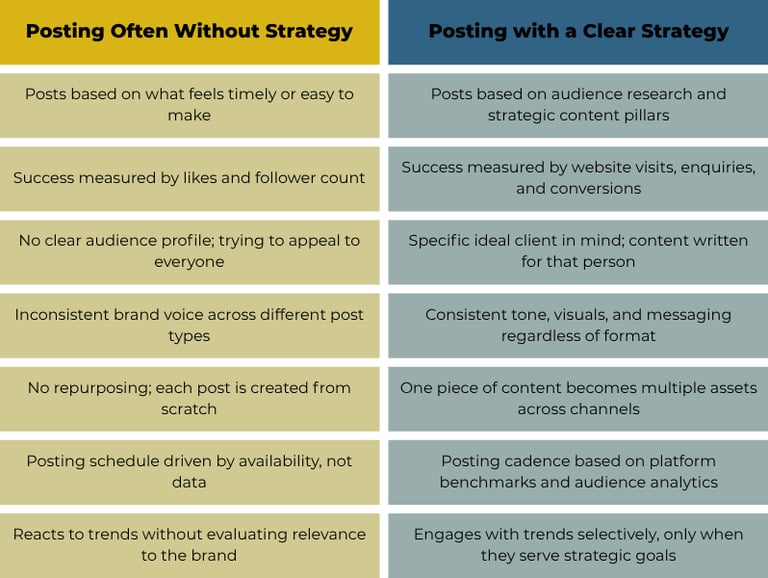
Here is the honest answer: posting frequently and having a social media strategy are not the same thing. In fact, they are barely related. Posting is an activity. Strategy is the system that decides what you post, why you post it, who you are trying to reach, and how you measure whether any of it is moving your business forward.
This article breaks down the most common social media myths that keep small business owners stuck in a cycle of effort without results, and explains what a strategy actually looks like in practice.
The Data Is More Than You Might Expect
According to HeyOrca's 2026 survey of 100+ social media managers: posting a lot does not automatically mean you have a social media strategy.
Socialinsider's 2026 benchmark report, analyzing 70 million posts, found that brands on Facebook reduced posting frequency by 48% and moved toward fewer, higher-quality updates. Engagement did not collapse. For many, it improved.
ThinkPod Agency's 2025 analysis found that lower posting frequency with higher-quality content is now producing better engagement results than constant posting, in part because AI-curated feeds reward relevance over volume.
And yet the belief that posting more equals growing more persists. Let us examine why that is wrong, myth by myth.
Five Myths That Keep You Posting Without Progress
These are the beliefs that feel logical until you examine the data behind them.


The Myth: If I post every day, the algorithm will reward me.
The Truth: Algorithms on every major platform now prioritize relevance and engagement signals over raw posting volume. Buffer's 2026 analysis of 15.7 million posts found no universal 'magic number' of posts per week that works across niches, account sizes, or platforms. What mattered more was whether your content generated meaningful engagement when it was posted. A post that gets saved, shared, and commented on tells the algorithm far more than ten posts that are scrolled past.


The Myth: More posts mean more visibility.
The Truth: Visibility is determined by how the algorithm distributes your content, not how often you create it. Instagram engagement rates held steady at around 0.48% in 2025 despite brands averaging five posts per week. That means most posts are reaching a fraction of even existing followers. Posting more into a low-distribution system does not solve the distribution problem. Strategy does, because strategy addresses the content quality, format, timing, and audience alignment that actually influence reach.


The Myth: My competitors are posting constantly, so I have to keep up.
The Truth: Volume-matching a competitor's posting schedule without a strategic reason to do so is one of the fastest ways to exhaust your team and dilute your content quality. Socialinsider's 2026 data shows that the brands reducing posting frequency on Facebook and reallocating resources to platforms with stronger organic reach are outperforming those maintaining high volume for its own sake. The question is not what your competitors are doing. It is what your audience responds to and where.


The Myth: Engagement (likes, follows, comments) means my strategy is working.
The Truth: Engagement metrics are directional, not definitive. A post can go viral without generating a single enquiry. Follower counts can grow without revenue growing alongside them. Heropost's 2026 analytics guide makes the distinction clearly: the number of posts published is an activity metric, not an outcome metric. What matters is whether your social media activity is driving website traffic, enquiries, calls, or sales. Social media analytics that stop at likes are measuring the wrong thing.
The Myth: If I just find the right posting time and hashtag formula, everything will click.
The Truth: Optimal posting times and hashtag research are tactical details. They are useful, but they operate within a strategy, not in place of one. HeyOrca's 2026 survey notes that posting at peak times matters only when the content itself is relevant and on-brand. Great timing on a post that does not connect with your audience's actual needs produces no meaningful result. The foundation has to be right before the tactics become worth optimizing.


What a Social Media Strategy Actually Looks Like
Strategy is not a content calendar with time slots filled in. That is a schedule, and schedules are useful tools, but they are outputs of strategy rather than strategy itself. A real social media strategy starts with four questions:
Who, specifically, are you trying to reach? Not 'small business owners' in general, but what kind, at what stage, with what problem, on which platform.
What action do you want them to take? Follow you, visit your website, book a call, share your content, remember your brand. Each outcome requires a different type of content.
What will you say that is useful, distinct, or credible? Your content needs to do something for the reader: solve a problem, answer a question, offer a perspective they have not considered, or build trust through demonstrated expertise.
How will you know if it is working? Not likes. Website traffic from social, enquiries that mention your content, conversion rates on landing pages linked from your posts.
Once those four questions are answered, you have the foundation. From there, strategy covers:
Platform selection (where does your audience actually spend time, and where does your content format work best)
Content mix (what proportion of your posts educate, entertain, build trust, or make a direct offer)
Brand voice and visual consistency (so that every post, regardless of topic, is recognizably yours)
Repurposing logic (how a single well-considered piece of content becomes five assets across channels)
Measurement framework (which metrics you check weekly, monthly, and quarterly, and what changes when those numbers move)
Notice that 'how many times per week should we post' is not the first question in any of this. It comes near the end, after you know what you are posting and why.
What the 2026 Platform Data Actually Tells Us
The most recent benchmark data from Socialinsider, Buffer, and Growth-onomics offers a clear picture of what is working across platforms. The common thread is not volume. It is intentionality.
LinkedIn budgets grew 31.7% from Q3 2024 to Q3 2025, far outpacing Google's 6% increase over the same period. The platform's average engagement rate sits at around 2.05%, with some data showing median rates as high as 6.5% for well-targeted content. PDF carousels outperform all other formats, driving median engagement rates of 21.77%, which is three times higher than video or images. The recommended posting cadence is two to five times per week. Brands posting more than that without a corresponding increase in content quality see diminishing returns.
Instagram's overall engagement rate held at approximately 0.48% in 2025, essentially flat year over year. But the format gap is striking. Reels deliver 36% more reach than carousels, and carousels generate 12% more engagement than static images. In other words, what you post matters far more than how often you post. Buffer's research found that three to five posts per week yields the best growth, with diminishing returns beyond that threshold.
Facebook tells the clearest story. Brands that reduced their posting frequency by 48% and moved toward curated, high-value content did not see their performance collapse. This reflects what the platform's algorithm has been signaling for years: engagement quality is weighted more heavily than posting volume. If you are posting on Facebook daily with low engagement, you are likely training the algorithm to distribute your content less, not more.
TikTok
TikTok's average engagement rate rose 49% year over year to 3.70%, the highest of any major platform. Shares per post grew 45%, which reflects the platform's shift toward content people want to pass on rather than just watch. Even here, HeyOrca's survey found that small business accounts with irregular posting schedules sometimes outperform daily posters when their content is more intentional and niche-relevant.
The Pattern Across All Platforms
Every platform rewards content that generates meaningful interaction. Meaningful interaction comes from knowing your audience, choosing the right format, writing with a clear point of view, and giving people a reason to save, share, or respond. None of those things are solved by posting more often. They are solved by thinking more clearly before you post.
Why This Is Hard to Do Alone
None of this is meant to be discouraging. Understanding the difference between posting and strategy is the first step toward actually getting value from your social media presence.
The reason most small business owners end up in posting-without-strategy mode is not that they do not care about results. It is that building a strategy takes time, research, and a degree of distance from the business that is genuinely difficult when you are also running the business. It requires knowing what your competitors are doing and finding a way to be distinct from them. It requires understanding which content formats your audience prefers on each platform. It requires having a measurement system in place before you start, not after three months of posting.
And it requires consistency, not just in frequency, but in voice, in visual identity, and in the quality of what you produce. Occasional high-effort posts mixed with low-effort filler content do not build a recognizable presence. They send mixed signals to both the algorithm and the audience.
This is where working with a team changes things. Not because a team can post faster, but because a team can hold the strategy together over time, apply it consistently across formats and platforms, measure it against real business outcomes, and adjust it when the data says something is not working.
A Quick Check: Are You Posting or Strategizing?
Ask yourself these questions about your current social media activity:
Can you name the specific type of person your content is written for, beyond 'anyone who might need my service'?
Do you know which posts from the last three months drove actual website visits or enquiries, not just likes?
Is there a consistent voice and visual style across all your posts, including the ones you made quickly?
Do you have a reason (based on data or research) for posting on the platforms you are on?
When a post underperforms, do you know why, and does that change what you do next?
If most of those answers were 'not really' or 'I am not sure,' you are in good company. Most small businesses are in the same position. But now you know what you are missing, which puts you ahead of most.
Ready to turn your social presence into something that actually works?
At Impasto Creative Solutions, we build social media strategies from the ground up: audience research, platform selection, content frameworks, brand voice, and measurement systems that connect your social activity to real business results. We do not just help you post more. We help you post with purpose.
Get in touch at impastocreatives.com and let us look at what your social media presence could actually be doing for your business.
Sources
1. Buffer. (2026). The State of Social Media Engagement in 2026: 52M+ Posts Analyzed. Analysis of 15.7 million posts found no single best posting frequency that works across platforms, niches, or account sizes. buffer.com/resources/state-of-social-media-engagement-2026/
2. HeyOrca. (February 2026). Optimal Social Media Posting Frequency by Platform: 2026. Survey of 100+ social media managers confirming that posting frequency alone does not constitute a social media strategy. heyorca.com/blog/social-media-posting-frequency-by-platform-2026
3. Socialinsider. (2026). Social Media Benchmarks for 2026: 70 Million Posts Analyzed. Instagram engagement rate at 0.48%; TikTok engagement rate at 3.70% (up 49% year over year); Facebook brands reduced posting frequency by 48%. socialinsider.io/social-media-benchmarks
4. ThinkPod Agency. (December 2025). Top Social Media Statistics for 2025. Lower posting frequency with higher quality content is producing better engagement results than constant posting. thinkpodagency.com
5. Heropost. (April 2026). The Complete Guide to Social Media Analytics: Metrics That Actually Matter in 2026. Number of posts published is an activity metric, not an outcome metric. heropost.io/social-media-analytics-guide-2026/
6. Growth-onomics. (March 2026). 2026 Social Media Benchmarks by Industry. LinkedIn budgets grew 31.7% from Q3 2024 to Q3 2025. LinkedIn PDF carousels drive median engagement of 21.77%, three times higher than video or images. growth-onomics.com
7. Automateed. (December 2025). Optimal Posting Frequency in 2026: How Creators Can Maximize Reach. Buffer's 2025 analysis confirms 3 to 5 posts per week on Instagram yields the best growth, with diminishing returns beyond that. automateed.com
8. AutoFaceless. (April 2026). Social Media Engagement Statistics 2026: Platform Benchmarks, Video Performance, and Algorithm Trends. Reels deliver 36% more reach than carousels on Instagram; carousels generate 12% more engagement than static images. autofaceless.ai
9. HubSpot. (2025). State of Marketing Report 2024/2025. Short-form video delivers the highest ROI for 21% of marketers. hubspot.com/marketing-statistics
10. Impasto Creative Solutions. (2026). Keyword Cluster Research: 26 Clusters for Digital Marketing for Small Businesses. Internal document.
11. Impasto Creative Solutions. (2026). Blog Content Plan: Comprehensive Topic List. Internal document.
IMPASTO CREATIVE SOLUTIONS
We make your brand visible, searchable, and impossible to ignore. Let’s get started today.