SEO vs. Paid Ads: Which Should I Prioritize First?
A breakdown of two powerful marketing channels, what each one actually does, and how to decide where to put your budget when you cannot do everything at once.
SEOBEGINNER'S GUIDEPAID ADSCOMPARISON

If you have spent any time looking into digital marketing for your business, you have almost certainly run into this question. Should you invest in SEO, which builds your visibility in search results over time? Or should you run paid ads, which can put your business in front of people today?
Both channels can work. Both are worth understanding. But they work differently, deliver results on different timelines, and serve different purposes in a marketing strategy. And if your budget is limited, choosing where to start matters.
This article walks you through exactly what each channel does, what results you can realistically expect from each, and how to decide which one makes more sense for where your business is right now. The short answer is that SEO should be your foundation, and paid ads are the accelerator you add on top. But the longer answer is more useful, so let us get into it.
Before we go further: what are we actually comparing?
SEO (Search Engine Optimization) is the process of improving your website and its content so that it appears organically in search results when someone searches for what you offer. You do not pay per click. You earn visibility by building relevance, authority, and technical quality over time.
Paid Ads (Pay-Per-Click / PPC) is the process of paying to appear at the top of search results or social media feeds. You bid on keywords or audiences and pay each time someone clicks your ad. Results can appear within days of launching a campaign.
SEO: Building Something That Compounds Over Time
Think of SEO as buying property rather than renting space. When you invest in SEO, you are building an asset: a website with content that ranks, a domain with authority, and a presence in search results that belongs to you. Nobody can remove it the moment you stop paying. It grows as you invest in it, and the returns tend to increase over time rather than plateau.
The tradeoff is time. SEO is not instant. Most businesses begin to see meaningful results between six and twelve months after starting. The peak performance window is typically years two and three of consistent investment. For a business that needs customers next week, SEO alone is not enough. But for a business thinking about where it wants to be in two years, starting SEO today is one of the most important decisions it can make.
What SEO involves in practice
Researching the exact words and phrases your potential customers type into search engines
Creating content (blog posts, service pages, FAQs) that answers those searches clearly and completely
Making your website technically sound: fast loading, mobile-friendly, easy for Google to read
Building credibility signals so search engines see your site as authoritative and trustworthy
Optimizing local visibility through your Google Business Profile and location-specific content
What the data says about SEO returns
748% median ROI — a well-executed SEO campaign returns $7.48 for every $1 invested (FirstPageSage, 2025 / Sagapixel)
14.6% close rate — organic search leads convert at nearly 9x the rate of outbound marketing leads, which close at 1.7% (SeoProfy / Single Grain)
5.8x more leads per dollar — organic SEO costs approximately $31 per lead, compared to $181 per lead for paid ads (HubSpot)
8x long-term ROI — SEO delivers 8x ROI over time, compared to 4x for PPC, with compounding performance and decreasing marginal cost (SeoProfy, 2026)
#1 ROI-generating channel — website, blog, and SEO was ranked the top ROI channel by 27% of marketers in HubSpot's 2026 State of Marketing Report
Those numbers are compelling, but it is worth being clear about what they require: consistent investment in content, technical maintenance, and strategy. SEO is not a one-time fix. It is an ongoing process of building and improving. That is also why the returns compound: every new piece of quality content you publish, every technical improvement you make, every credible link your site earns adds to the foundation.
Paid Ads: Speed and Precision When You Need Results Now
Paid ads work like renting a prime billboard on the busiest road in town. The moment you pay, your business appears where your customers are looking. The moment you stop paying, you disappear. That is not a criticism: it is just the nature of the channel, and it makes paid ads exceptionally useful for specific situations.
When a campaign is well set up and well managed, paid ads can generate enquiries and sales within days of launching. They are also highly controllable: you can target specific audiences, set daily budget limits, test different messages, and adjust in real time based on what the data shows. For businesses with a clear offer, a well-defined audience, and a strong landing page, paid ads can deliver a fast and measurable return.
What paid ads involve in practice
Choosing the right platform for your audience (Google Ads for high-intent search; Meta Ads for interest-based discovery)
Researching the keywords or audience segments you want to target
Writing compelling ad copy that earns the click
Building or optimizing the page people land on after clicking (the landing page determines whether they convert)
Managing bids, budgets, and targeting settings to reduce wasted spend
Reviewing performance data regularly and adjusting campaigns based on what works
What the data says about paid ads
Immediate traffic — a campaign can be live and driving visitors within 24 to 48 hours of launch (ACSIUS, 2026)
200% average PPC ROI — effective PPC optimization is associated with average returns of $2 for every $1 of ad spend, or a 200% ROI (WordStream, 2026)
Precise targeting — Google and Meta Ads allow targeting by keyword intent, location, demographics, interests, and past website visitors (retargeting)
Full budget control — you set a daily or monthly spending limit and can pause or adjust campaigns at any time based on performance
80% of businesses use PPC — paid advertising is widely used because it works for launches, seasonal campaigns, and driving fast lead flow (SeoProfy, 2026)
The important caveat with paid ads is cost sustainability. Cost-per-click rates rise steadily as competition increases. If your business becomes dependent on paid ads as its primary source of leads, you are on a treadmill: the moment the budget stops or the ad performance drops, the leads stop with it. Paid ads are most powerful as a complement to an organic foundation, not as a replacement for one.
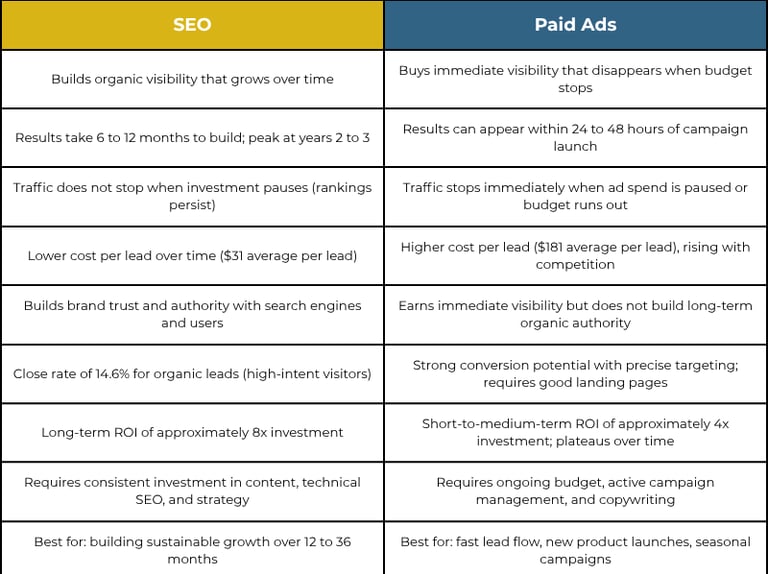
SEO vs. Paid Ads: Side by Side
Here is a direct comparison of the two channels across the factors that matter most to a small business owner making a budget decision.
What Results Can You Actually Expect?
Let us make this practical. Here is what businesses typically see from each channel when it is set up and managed properly.
Results from SEO (12 to 36 months)
✓ More pages of your website appearing in search results for relevant keywords
✓ Steady increase in organic (free) website visitors month over month
✓ Enquiries from people who were already looking for what you offer
✓ Reduced dependence on paid channels as organic visibility grows
✓ Higher trust signals from search engines, leading to broader content ranking
✓ Improved local visibility in Google Maps and local search results
✓ A content library that continues attracting visitors long after it is published
Results from Paid Ads (weeks to months)
✓ Immediate traffic to specific pages or offers from day one of launch
✓ Leads and enquiries that can be tracked directly to ad spend
✓ Ability to test messaging and offers quickly and cheaply before committing
✓ Highly targeted reach (by location, search term, or audience profile)
✓ Fast data on which ad copy, audiences, and landing pages convert best
✓ Scalable spend: increase budget when campaigns perform, reduce when they do not
✓ Visibility in competitive search results where organic ranking takes longer
How to Decide: A Practical Guide for Different Situations
The right answer depends on your business stage, your budget, and your timeline. Here are the most common scenarios and what we would recommend for each.
Situation: You are a new business with no online presence
Best start: Start with SEO foundations, add ads for faster early visibility
Before paid ads can convert effectively, you need a website that earns trust. Start by getting your website and Google Business Profile properly set up, then run targeted ads while your organic presence builds.
Situation: You have a website but it is not bringing in enquiries
Best start: SEO first
If your website exists but does not rank, it is not being found. Paid ads can drive temporary traffic, but if the website does not convert, that spend is wasted. Fix the foundation with SEO before paying for traffic.
Situation: You need leads quickly for a specific offer or campaign
Best start: Paid Ads
For a product launch, a seasonal promotion, or a specific short-term goal, paid ads are the right tool. They can generate results fast while your longer-term SEO investment builds in the background.
Situation: You are spending on ads but the cost keeps rising and results are inconsistent
Best start: Add SEO to reduce paid dependency
Rising cost-per-click is a sign that paid channels alone are becoming less sustainable. Building organic traffic through SEO will reduce your dependence on ad spend over time and lower your overall cost per lead.
Situation: You have a steady business and want to grow without proportionally growing your ad budget
Best start: SEO as the primary investment
Organic growth through SEO compounds without requiring you to increase spend proportionally. As content ranks and authority builds, your cost per lead decreases, and the returns keep growing.
Why the Best Approach Is Usually Both
The businesses getting the strongest digital marketing results in 2026 are not choosing between SEO and paid ads. They are using both in a coordinated way.
The logic is straightforward. SEO builds the foundation: a website that ranks, content that attracts the right visitors, and an organic presence that does not disappear when the budget is tight. Paid ads add speed and precision on top of that foundation: amplifying what is working, reaching audiences that organic search has not yet captured, and filling gaps while the SEO investment matures.
Running paid ads without SEO means you are renting your entire audience indefinitely. Running SEO without paid ads means you may be missing opportunities for faster growth and testing. Running both means each channel strengthens the other.
The proportion of investment between the two channels depends on your situation. Early-stage businesses often need to weight more heavily toward SEO to build the foundation. Businesses with proven offers and stronger budgets can run both more equally. The key is having a plan that connects the two rather than treating them as competing choices.
One number worth remembering
Organic search generates 44.6% of all revenue attributed to digital channels across industries. That is not traffic. That is revenue. And it comes from people who found you without you having to pay for every single click. That is the long-term case for SEO in one number.
Not sure where to start for your business specifically?
At Impasto Creative Solutions, we help small business owners figure out exactly which combination of SEO and paid advertising makes sense for their budget, their timeline, and their goals. We do not push a one-size-fits-all approach. We look at where you are, where you want to be, and what the most efficient path between those two points actually looks like.
We offer both SEO services and paid ads management, which means we can help you build the foundation and accelerate growth at the same time, with both channels working together toward the same business goals.
Get in touch at impastocreatives.com for a no-pressure conversation about where your digital marketing budget will work hardest for your business.
Sources
1. HubSpot. (2026). State of Marketing Report 2025/2026. Website, blog, and SEO ranked as the top ROI-generating channel by 27% of marketers. Small businesses are 23% more likely than average to see ROI from blog posts. hubspot.com/marketing-statistics
2. SeoProfy. (March 2026). SEO ROI Statistics for 2026: Data, Benchmarks and Trends. SEO delivers 8x long-term ROI versus 4x for PPC. Organic SEO costs approximately $31 per lead versus $181 for PPC. Organic search generates 44.6% of all revenue attributed to digital channels. seoprofy.com/blog/seo-roi-statistics/
3. SeoProfy. (February 2026). 113 Digital Marketing Statistics for 2026. SEO delivers stronger long-term ROI at 8x versus 4x for PPC. Effective PPC optimization associated with 200% average ROI. 80% of businesses rely on PPC advertising for growth. seoprofy.com/blog/digital-marketing-statistics/
4. FirstPageSage. (2025). SEO ROI Statistics and Benchmarks. Thought leadership SEO campaigns deliver approximately 748% ROI. SEO converts 7.3x more than PPC in financial services. firstpagesage.com
5. Single Grain / Sagapixel. (October 2025). Is It Worth Investing Into SEO in 2025? Median SEO ROI of 748%, or $7.48 for every $1 spent. Organic leads close at 14.6% versus 1.7% for outbound. singlegrain.com
6. CI Web Group. (September 2025). Average ROI from SEO vs Paid Ads in the Trades. SEO delivered nearly 5x better return on ad spend than paid ads for home service businesses in a tracked January to April 2025 study. ciwebgroup.com
7. First Page Sage. (December 2025). E-Commerce SEO ROI Report. Paid ads deliver immediate results but ROI plateaus. SEO is the only channel with both compounding performance and decreasing marginal cost over time. firstpagesage.com
8. ACSIUS. (March 2026). SEO vs Paid Ads: What Works Best in 2026? Paid ads can drive traffic within 24 to 48 hours of launch. In 2026, the most successful businesses are combining both SEO and paid ads. acsius.com
9. Markterior. (March 2026). SEO vs Google Ads in 2026: What to Invest In. Businesses investing in SEO experience compounding growth; ad-dependent businesses face rising customer acquisition costs. markterior.com
10. WordStream. (2026). Conversion Rate Optimization Statistics. Effective PPC optimization yields average returns of $2 for every $1 of ad spend, equivalent to 200% ROI. wordstream.com
11. Impasto Creative Solutions. (2026). Keyword Cluster Research: 26 Clusters for Digital Marketing for Small Businesses. Internal document.
12. Impasto Creative Solutions. (2026). Blog Content Plan: Comprehensive Topic List. Internal document.
IMPASTO CREATIVE SOLUTIONS
We make your brand visible, searchable, and impossible to ignore. Let’s get started today.